Grandma Josephine
Charlie and the Chocolate FactoryGrandma Josephine is Charlie Bucket’s maternal grandmother and one of the four very old grandparents who share the crowded Bucket household. Her place in the family is physically restricted by poverty and age, but emotionally central: she belongs to the generation whose love makes Charlie’s difficult childhood bearable and whose responses help frame the moral contrasts surrounding the Golden Tickets.
Identity and Household
Grandma Josephine is the mother of Mrs Bucket, while Grandpa Joe is the father of Mr Bucket. She lives with Grandpa Joe, Grandpa George, Grandma Georgina, Mr Bucket, Mrs Bucket, and Charlie Bucket in a small wooden house on the edge of a great town. The house contains only two rooms and one bed. The bed is reserved for the four grandparents because they are extremely old and tired, while Charlie and his parents sleep on mattresses on the floor. In winter, freezing draughts cross the floor throughout the night, and the family cannot afford either a larger house or another bed.
This arrangement makes Grandma Josephine a visible part of the family’s poverty rather than a distant background relative. The grandparents’ shared bed represents both deprivation and dependence: they have little physical space, little comfort, and almost no independent activity, yet they remain fully involved in the family’s emotional life. Their circumstances also sharpen the importance of Charlie’s presence, since the household has few material resources with which to express affection.
Affection for Charlie
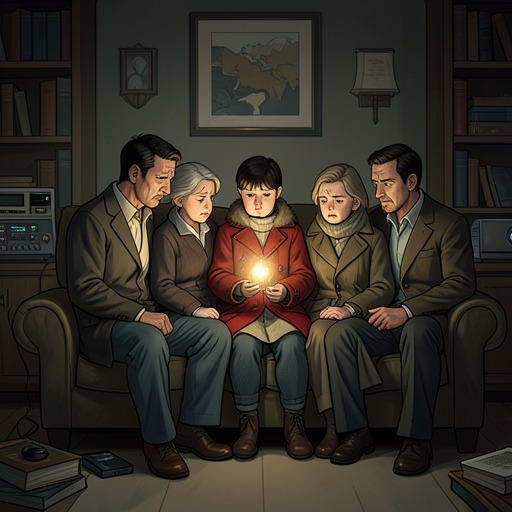
Every one of the four grandparents is over ninety, and during the day they lie huddled together in bed, dozing with nothing to do. Charlie Bucket’s evening visits transform that stillness. When he enters the room and greets Grandma Josephine, Grandpa Joe, Grandpa George, and Grandma Georgina, their wrinkled faces brighten and they sit up to talk. The grandparents love Charlie deeply; he is described as the only bright thing in their lives, and they look forward to his visits throughout the day.
The room consequently becomes more than a place where old people lie waiting. For roughly half an hour each evening, Charlie listens to the grandparents’ stories, sometimes with Mr Bucket and Mrs Bucket standing at the door. The whole family can forget that it is hungry and poor. Grandma Josephine’s significance lies partly in this recurring ritual: she participates in a shared imaginative world that temporarily displaces the family’s empty stomachs, cold floor, and financial helplessness.
Her affection also gives context to Charlie’s deprivation. Charlie feels hunger most severely, and his parents often surrender their own portions of lunch or supper to him, without being able to provide enough food for a growing boy. He longs above all for chocolate, which he sees in shop windows and among other children’s possessions. Once a year, on Charlie Bucket’s birthday, the family saves enough money to give him one small chocolate bar. He preserves it in a small wooden box, taking tiny nibbles so that the sixpenny bar lasts for more than a month. Grandma Josephine belongs to the family economy that makes this modest gift possible: chocolate is not an ordinary snack but a carefully protected token of collective love.
Response to the Golden Tickets
When Willy Wonka announces that five children will be allowed to visit Wonka’s Chocolate Factory, Grandma Josephine joins the family’s conversation about the impossible opportunity. Charlie Bucket admits that he receives only one chocolate bar a year, and therefore believes he has no chance of finding a Golden Ticket. Grandma Georgina encourages him by saying that he has as much chance as anybody else, but Grandpa George immediately gives the harder economic assessment: the children who find tickets will be those who can afford to buy chocolate bars every day, whereas Charlie can buy only one a year.
Grandma Josephine’s household thus witnesses the contest from the disadvantaged side of the consumer frenzy. The worldwide search turns chocolate into a scarce prize and encourages adults and children to buy bars in enormous quantities. Wealthy families can convert money directly into repeated chances, while Charlie’s family cannot. Grandma Josephine’s presence helps keep that inequality personal: the contest is not merely a public game but an event watched by a family whose resources barely cover food.
She also supplies one of the story’s clearest judgments on the other ticket holders. After Augustus Gloop is celebrated for finding a ticket, his mother explains that he eats many chocolate bars every day and treats eating as his chief interest. Grandma Josephine calls both the mother and the boy revolting, while Grandma Georgina calls them repulsive. The judgment is blunt, but it establishes the grandparents as observers who distinguish appetite and privilege from qualities they value in Charlie.
Charlie’s Discovery and the Factory Journey
When Charlie Bucket finds the fifth Golden Ticket, Mrs Bucket is serving the grandparents their evening soup. Charlie rushes into the room, announcing that he found money in the street, bought two bars of chocolate, and discovered the ticket in the second bar. The four grandparents are sitting up in bed with bowls of soup balanced on their laps. At the announcement, they all drop their spoons and freeze against their pillows; for about ten seconds, the room falls into absolute silence.
The reaction shows how completely the discovery interrupts ordinary hardship. Soup, spoons, and the shared bed belong to the family’s daily struggle, while the Golden Ticket opens onto abundance, secrecy, and spectacle. Grandma Josephine is not described as delivering the first response, but her stunned stillness is part of the collective shock through which the family recognizes that Charlie’s life has suddenly changed.
The visit is scheduled for the first day of February, which is immediately imminent when the family realizes that the current day is the last day of January. Grandpa Joe urges Charlie to prepare at once, listing the practical tasks required before the biggest day of his life: washing his face, combing his hair, scrubbing his hands, brushing his teeth, cutting his nails, polishing his shoes, ironing his shirt, and removing the mud from his trousers. Grandma Josephine shares in the household’s sudden movement from scarcity to preparation, even though the evidence does not assign her a particular task. The family must decide which adult will accompany Charlie, and the urgency of the departure contrasts sharply with the grandparents’ usual confinement.
Outside Wonka’s Chocolate Factory, enormous crowds gather to watch the five ticket holders enter. The police shield the children and their accompanying adults from the crowd. Charlie Bucket stands beside the gates holding Grandpa Joe’s hand; unlike the other children, who arrive with both parents, Charlie has only one accompanying adult. Grandma Josephine is not among the adults at the gates, but the contrast emphasizes the family’s limited choices and the special importance of Grandpa Joe’s role in carrying the household’s hopes into the factory.
Place in the Ending and Thematic Role
Grandma Josephine’s relationship to the factory’s ultimate succession is indirect but significant. Willy Wonka explains that he has no children or family of his own and needs someone to keep the factory operating, partly for the sake of the Oompa-Loompas. He does not want a grown-up successor, because an adult would not listen or learn in the required way; he wants a good, sensible, loving child to whom he can reveal his most precious sweet-making secrets. Charlie Bucket’s family, including Grandma Josephine, therefore stands behind the child who is judged capable of inheriting a world of abundance.
Her narrative function is not to compete for attention with the ticket holders or to control the plot. Instead, she anchors the moral and domestic scale against which the factory’s extravagance is measured. She belongs to a family that cannot buy a better house, cannot provide enough food, and can give Charlie chocolate only once a year, yet it provides him with affection, stories, restraint, and communal joy. Through Grandma Josephine, old age and poverty are not presented only as misery: the grandparents’ room becomes a small social world in which Charlie is cherished and in which the family can temporarily escape hunger. That emotional wealth forms the quiet counterpoint to the commercial wealth displayed by the Golden Ticket winners.